
Understanding ECMO
A Parent-Friendly Guide for Families
Hearing the word ECMO for the first time can feel incredibly overwhelming. Many parents hear this term during one of the most frightening moments of their child’s medical journey, often when their baby or child is critically ill.
When doctors mention ECMO, it usually means your child needs extra support to help their heart or lungs do their job while their body heals.
While ECMO can sound scary, it is a medical tool designed to give children time, support, and the best possible chance for recovery.
What Is ECMO?
ECMO stands for Extracorporeal Membrane Oxygenation.
That may sound like a complicated medical phrase, but the idea behind ECMO is actually easier to understand.
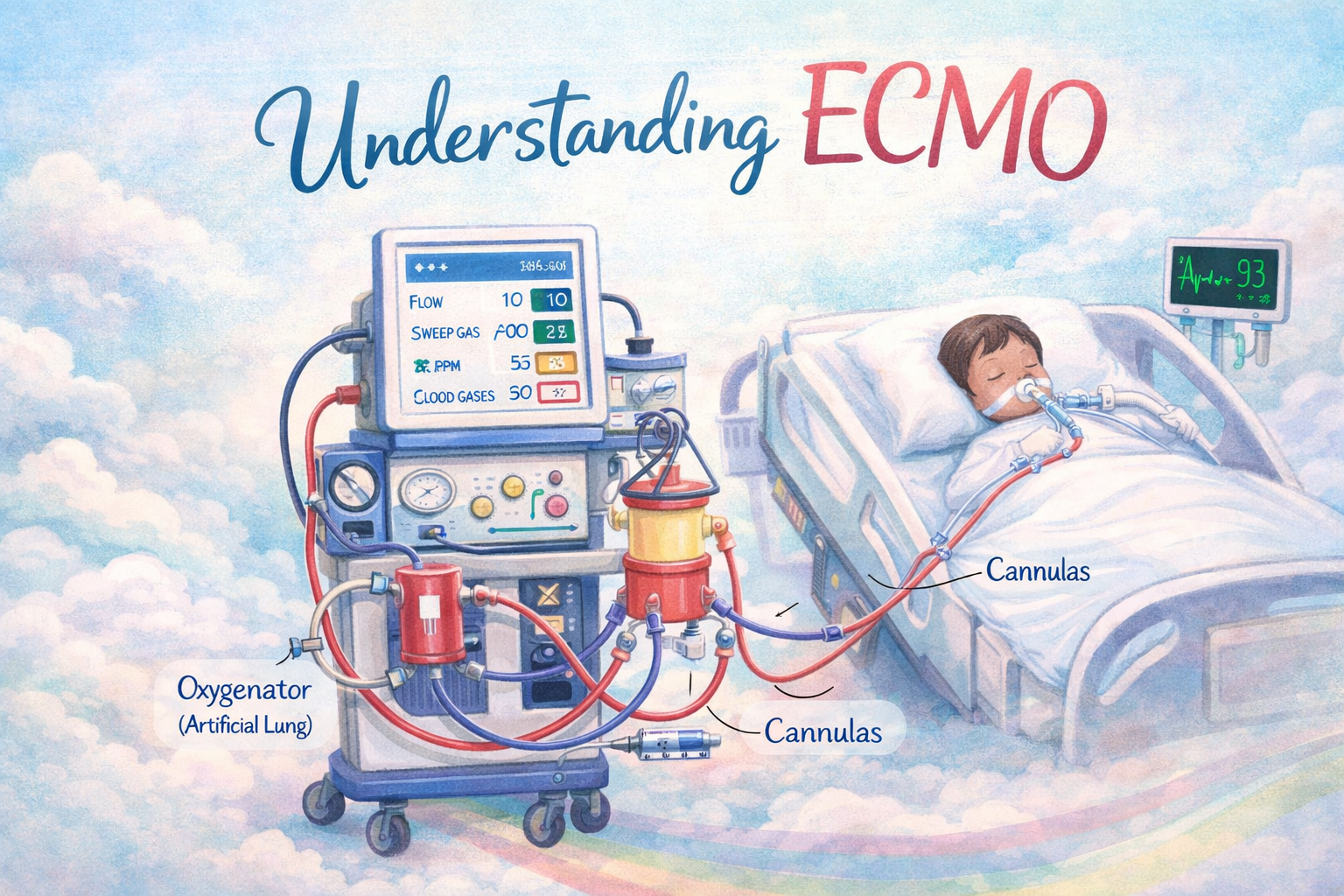
In simple terms, ECMO is a machine that temporarily acts like the heart and lungs when those organs are too weak or sick to function properly on their own.
The ECMO machine takes blood from the body, adds oxygen to it, removes carbon dioxide, and then sends the blood back into the body.
This process helps make sure the body continues receiving the oxygen it needs to survive.
At the same time, it gives the heart and lungs a chance to rest and recover.
Why Would a Child Need ECMO?
Doctors may recommend ECMO when a child’s heart or lungs are not able to provide enough oxygen to the body, even with other treatments like medications or breathing machines.
Some situations where ECMO might be used include:
• Complications after heart surgery
• Severe congenital heart disease
• Heart failure or heart rhythm problems
• Serious lung infections or breathing failure
• When a child’s heart or lungs need time to recover after a major medical event
ECMO is often considered when doctors have tried other treatments but feel the body needs more support than those treatments can provide alone.
It is sometimes described as a bridge, meaning it helps support the body until the heart or lungs improve, until another treatment can be done, or until doctors can determine the next step in care.
How Does ECMO Work?
ECMO works by moving blood outside of the body through a specialized machine.
During ECMO treatment, doctors place small tubes called cannulas into large blood vessels. These tubes allow blood to travel from the body into the ECMO machine.
Inside the machine:
• Blood passes through a special filter called a membrane oxygenator
• Oxygen is added to the blood
• Carbon dioxide is removed
• The blood is warmed and monitored carefully
Once the blood has been oxygenated, it is returned to the body, helping supply the brain, organs, and tissues with oxygen.
This process continues continuously while the body receives the support it needs.
Types of ECMO
There are two main types of ECMO that doctors may use depending on what kind of support the body needs.
VA ECMO (Veno-Arterial ECMO)
This type supports both the heart and lungs.
Blood is taken from a vein and returned to an artery, helping the ECMO machine assist with both circulation and oxygen delivery.
This type is often used for children with serious heart conditions or complications after heart surgery.
VV ECMO (Veno-Venous ECMO)
This type mainly supports the lungs.
Blood is taken from a vein, oxygenated by the ECMO machine, and returned to a vein.
The child’s heart continues pumping normally, but ECMO helps with breathing and oxygen levels.
What Parents May See in the ICU
Seeing your child connected to ECMO equipment can be extremely overwhelming.
Parents may notice:
• Large tubes connected to the ECMO machine
• A ventilator helping the child breathe
• Monitors tracking oxygen levels, heart rate, and blood pressure
• IV medications and fluids
• A team of doctors and nurses closely watching every detail
The machines and equipment may look intimidating, but they are there to support the body and keep it stable during a very critical time.
Many children on ECMO are closely monitored by a specialized medical team trained to manage this life-support technology.
How Long Are Children on ECMO?
The length of time a child stays on ECMO can vary widely.
Some children may only need ECMO support for a few days, while others may require it for longer periods depending on their condition and how their body responds.
Doctors regularly perform tests and monitor progress to determine when the heart and lungs are ready to take over again.
When the medical team believes the child’s body is strong enough, they begin the process of weaning off ECMO.
Risks and Challenges
Because ECMO is used for very serious medical situations, it does come with risks.
Some challenges may include:
• bleeding
• infections
• blood clots
• complications related to the underlying illness
However, doctors carefully weigh these risks against the potential benefits of ECMO, especially when a child needs life-saving support.
ECMO is typically used when the medical team believes it offers the best chance to support the body during a critical illness.
For Parents Walking This Journey
If your child is on ECMO, you may be experiencing one of the most difficult and uncertain moments of your life.
It is normal to feel fear, confusion, exhaustion, and overwhelming emotions.
ECMO is used because doctors are doing everything they can to support your child and give their body time to recover.
You are not alone in this journey.
Many families in the congenital heart disease community have walked this road and understand how difficult these moments can be.
Parents often find strength in the support of their medical team, their loved ones, and other heart families who truly understand the journey.
🤍 At Opal’s Workshop of Love, our goal is to help families understand complex medical terms in ways that feel more approachable and less overwhelming.
Knowledge cannot remove the fear of these moments, but it can help parents feel more informed and supported as they navigate their child’s medical journey.
Understanding ECMO Terms
A Parent-Friendly Guide
When a child is on ECMO (Extracorporeal Membrane Oxygenation), parents may hear doctors and nurses use words that sound unfamiliar or even frightening.
Terms like “sweep,” “flows,” or “chugging” are often used by the medical team while monitoring the ECMO machine. These words are simply part of how the team talks about how the machine is working and how your child’s body is responding.
Below are some common ECMO terms parents may hear in the hospital.
Sweep (Sweep Gas)
The sweep controls how much carbon dioxide is removed from the blood by the ECMO machine.
You can think of sweep like the speed of a fan blowing air across the oxygenator.
• When sweep is increased, more carbon dioxide is removed from the blood
• When sweep is decreased, less carbon dioxide is removed
Doctors adjust the sweep to help keep the child’s blood gases balanced.
Parents may hear the team say things like:
“We’re increasing the sweep a little.”
or
“Her carbon dioxide looks good, so we can lower the sweep.”
This is simply part of adjusting the machine to match what the child’s body needs.
ECMO Flow
Flow refers to how much blood is moving through the ECMO circuit each minute.
This number tells doctors how much support the ECMO machine is providing.
Higher flow means the machine is doing more of the work of circulating blood and oxygen.
Lower flow may mean the heart is starting to take on more of the work again.
Flow is usually measured in liters per minute.
The ECMO team constantly watches this number to make sure the body is receiving enough oxygenated blood.
RPM (Pump Speed)
RPM stands for revolutions per minute.
This number describes how fast the ECMO pump is spinning to move blood through the circuit.
Higher RPM = faster pump movement.
Doctors adjust RPM to help maintain the correct flow of blood through the machine.
Chugging (or Chatter)
Parents sometimes hear the ECMO team mention “chugging” or “chatter.”
This happens when the tubing in the ECMO circuit vibrates or shakes because blood is not flowing smoothly into the pump.
It can happen when:
• the body needs more fluids
• blood pressure is low
• the pump is trying to pull more blood than the veins can provide
If chugging happens, the medical team may:
• give fluids
• adjust the pump settings
• reposition the cannulas
The team watches for this closely and responds quickly when it occurs.
Oxygenator
The oxygenator is often called the “artificial lung.”
This is the part of the ECMO machine that:
• adds oxygen to the blood
• removes carbon dioxide
It is one of the most important parts of the ECMO circuit.
Cannulas
Cannulas are the large tubes that connect your child’s body to the ECMO machine.
They allow blood to:
• leave the body
• travel through the ECMO machine
• return back to the body
These tubes are carefully placed into large blood vessels by surgeons or specialized doctors.
Oxygen Saturation (Sats)
Oxygen saturation, often called “sats,” measures how much oxygen is in the blood.
This is one of the most closely watched numbers in the ICU.
Children on ECMO often have their oxygen levels monitored continuously.
Blood Gases
Doctors frequently check something called blood gases while a child is on ECMO.
This test shows:
• oxygen levels
• carbon dioxide levels
• blood acidity (pH)
These numbers help the medical team decide if ECMO settings like sweep or flow need adjustment.
Why So Many Numbers?
The ECMO machine provides a lot of information about how a child’s body is functioning.
While the numbers and monitors can look overwhelming, they allow the medical team to make small adjustments that help support the child’s heart, lungs, and oxygen levels.
Every number the team watches helps guide decisions that support recovery.
For Parents in the ICU
Hearing unfamiliar medical terms while your child is critically ill can be incredibly stressful.
If you ever hear a word you don’t understand, it is completely okay to ask the medical team to explain it. Doctors and nurses want parents to feel informed and involved in their child’s care.
No question is too small when it comes to your child.